


Chiavari hosts three sanctuaries: Nostra Signora delle Grazie (Our Lady of Grace), Nostra Signora dell’Ulivo (Our Lady of the Olive Tree) in Bacezza and the most important one of all Nostra Signora dell’Orto (Our Lady of the Garden).
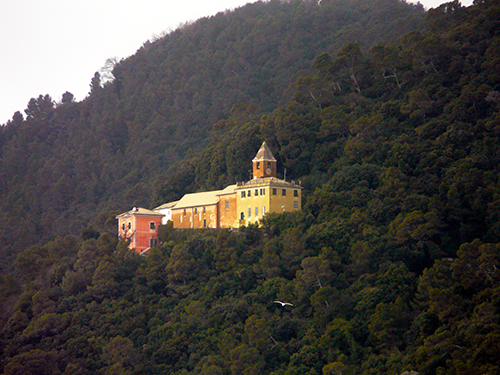
In a spectacular position along the Via Aurelia, on the cliffs overlooking the sea, Nostra Signora delle Grazie preserves an invaluable artistic heritage. The complex consists of a hospice for pilgrims, an older chapel dating back to the 18th century, and the splendid church decorated with frescoes by Teramo Piaggio and Luca Cambiaso. These frescoes, created between 1539 and 1550, depict the Stories of the Life of the Virgin and the Passion of Christ. The church houses the miraculous wooden statue of the Madonna, handcrafted in Flanders and brought to the sanctuary in 1416 by a Chiavarese captain. According to the legend, the ship carrying the statue could not leave the port until the statue was purchased.
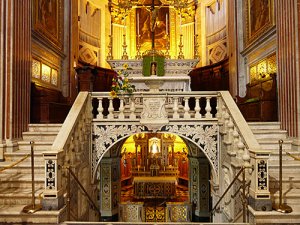
Nostra Signora dell’Ulivo in Bacezza, which is precisely one Roman mile from the Santuario delle Grazie was built to the devotion to a Byzantine-style image. Tradition says this image miraculously appeared among the branches of an olive tree, lighting up the night in the year 936 AD. Today, the building retains a primarily 19th-century appearance, and the miraculous image is preserved in the spectacular crypt.
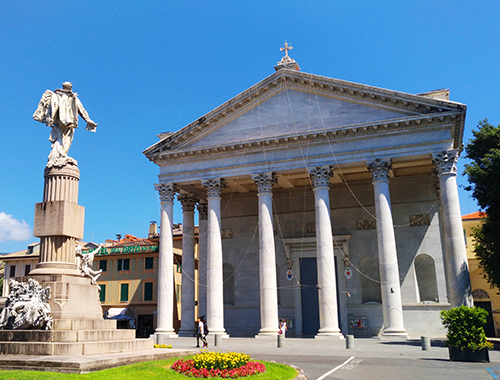
Nostra Signora dell’Orto is linked to the story of an apparition of the Virgin: in 1493, an image of the Madonna and Child was painted on a kitchen garden wall, in an area that was then outside the walls of the village. The Madonna was soon credited with miraculous powers, particularly during the plague of 1528. On 2 July 1610, the Virgin appeared to the peasant Sebastiano Descalzo near that very image, giving rise to a profound devotion, which led to the erection of the splendid sanctuary, later transformed into a bishop’s see.
The DIOCESAN MUSEUM
The natural completion of any building is its furnishings – furniture, objects, and decorative items. The patron families – the Counts of Lavagna – or the local communities related to them decorated the buildings with beautiful, valuable works, some of which are now preserved and displayed in the Diocesan Museum of Chiavari.
Two pieces of great importance come from Moneglia: a Limoges casket dating back to the 13th century, with angels in medallions in polychrome enamel – part of the liturgical furnishings from Santa Croce Church – and a canvas of the Madonna and Child from the Oratorio dei Disciplinanti, attributed to the mid-14th century and flanked by fragments of two saints and a praying man or client. The Polyptych of San Lorenzo, linked to San Lorenzo Church in Cogorno and dated 1492, is the work of an unknown painter close to Braccesco and Foppa.
From the Fieschi family “basilica” comes a 16th-century chalice of simple form, with an abraded coat of arms marked with a turret and the initials of the Genoese ravego – L. V. – perhaps the same person who participated in the creation of the Corpus Domini chest for the Cathedral of Genoa.
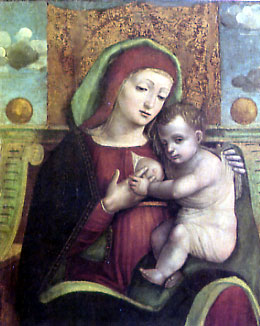
Another two important pieces came from San Giovanni Battista Church in Chiavari, founded by Bardo Fieschi: a panel of the Madonna and Child (c. 1360–1380) by a Ligurian artist influenced by Sienese painting, whose depiction of the Child touching His foot anticipates an iconography that later became widespread, though largely confined to the Ligurian region; and a second panel, the Madonna and Child, by Bernardino Fasolo – son of Lorenzo – dated 1512, from a family of artists linked by numerous commissions to the clan of the Counts of Lavagna.
Finally, one of the most precious objects belonging to the Lavagnina family – preserved here today for the multiple meanings it contains – is the Cross-Relic of Innocent IV. It is a pectoral cross containing a relic of the True Cross – used by the pontiff – and later mounted on a gilded silver support attributed to Genoese craftsmanship of the 16th century. The original cross – a Lorraine Cross – is made of rock crystal and finished in gilded silver. Recent research, which attributes its original case to a Constantinopolitan production from the first half of the 9th century, suggests that the precious artefact originates from the same place and time. This object – apparently donated to San Salvatore Church by Innocent IV himself – holds many symbolic meanings. It contains the most important relic in the Christian world. It was once the pectoral cross of a pope, is of ancient origin, and comes from the place where – by tradition – the “true relics” come from.
OTHER Important Churches
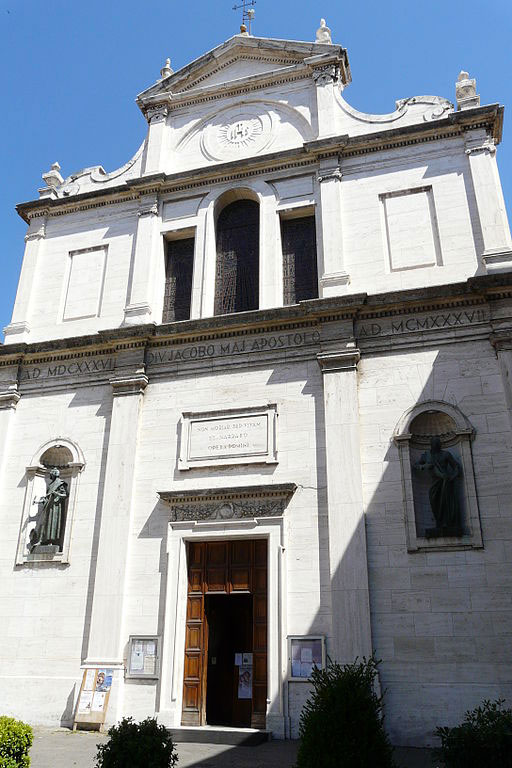 San Giacomo di Rupinaro Church
Founded around the year 1000, the church was known in the Middle Ages as San Giacomo de Arena, as it was located on the coast occupied by what is now Corso Millo. It stood on a pilgrimage route to Santiago de Compostela. In fact, it had a hostel (no longer in existence), and from the fourteenth century to the end of the eighteenth, it was entrusted to the Knights of St. John of Jerusalem, whose main role was to assist pilgrims. The building was rebuilt in 1637, and the modern façade was added in 1937.
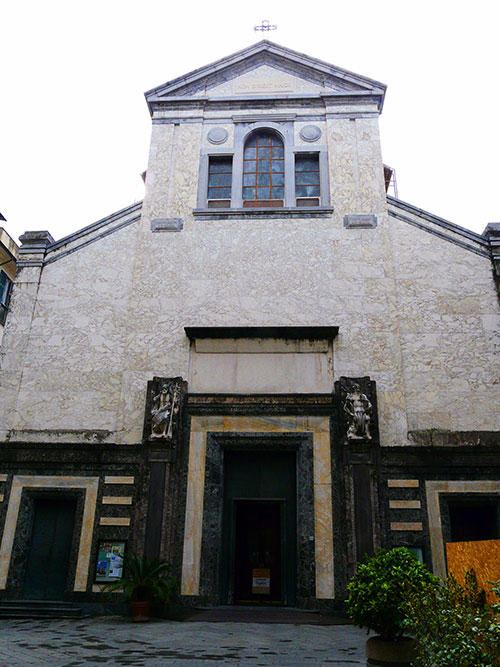
San Giovanni Battista Church
In the Middle Ages, Piazza di San Giovanni was the only square within the medieval village. The church of the same name, the Palazzo del Podestà (relocated to the Citadel at the beginning of the 15th century), and the homes of the Ravaschieri family (along the street that bears their name) all overlooked the square. The church stands on the ruins of a chapel founded, according to tradition, around 1182 by the archpriest of Lavagna, Bardo Fieschi. Between 1462 and 1468, the master Bernardo Giovanni di Luma from Como coordinated the first restoration of the building. It was later renovated in 1624 by Andrea Ceresola, known as Il Vannone, architect of the Republic of Genoa. On that occasion, the noble Costaguta family commissioned Bartolomeo Bianco to build the apse, which contains the tombs of several family members. The modern façade was built in 1935, based on a design by the architect Gaetano Moretti.
Inside the church features works by Bernardino Fasolo (15th century), Gian Battista Carlone, Domenico Piola, Orazio De Ferrari, Domenico Fiasella (17th century), Giuseppe Galeotti (18th century) and a wooden cross by Antonio M. Maragliano.
The Shrine, former San Francesco Church, now the Auditorium. It was built in 1631 by the sculptor Giuseppe Ferrandino commissioned by Achille Costaguta, who wanted to place it in the chapel inside San Francesco Church. At an unknown time and for unknown reasons, it was later moved outside. In 2001, it was restored by the Chiavari Host Lions Club.